Want To Refer To Scholarly Publications In Your Work?
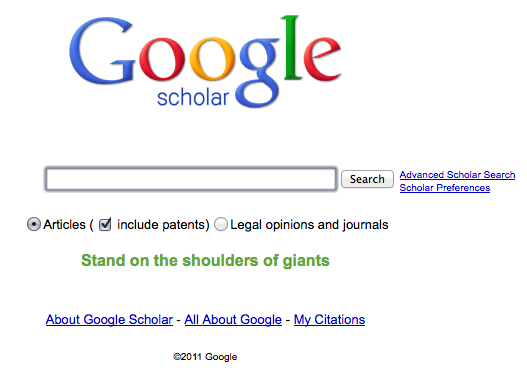
Are you in a niche where you’d like to write content that references scholarly content from academic publishers, universities, professional societies, librarians and more? Using these types of references in your work can dramatically add to the credibility of your articles and they are easier to find than you may think. Simply use Google’s search engine for scholarly search: Google Scholar.
Want To Be Considered A Scholarly Resource?
If you are an educational professional, etc. and would like the content of your site to be considered as a resource for the Google Scholar search engine, here are the content guidelines straight from the horse’s mouth that you need to consider:
Content Guidelines
- The content hosted on your website must consist primarily of scholarly articles – journal papers, conference papers, technical reports, or their drafts, dissertations, pre-prints, post-prints, or abstracts. Content such as news or magazine articles, book reviews, and editorials is not appropriate for Google Scholar. Documents larger than 5MB, such as books and long dissertations, should be uploaded to Google Book Search; Google Scholar automatically includes scholarly works from Google Book Search.
- Users click through to your website to read your articles. To be included, your website must make either the full text of the articles or their complete author-written abstracts freely available and easy to see when users click on your URLs in Google search results. Your site must not require users (or search robots) to sign in, install special software, accept disclaimers, dismiss popup or interstitial advertisements, click on links or buttons, or scroll down the page before they can read the entire abstract of the paper. Sites that show login pages, error pages, or bare bibliographic data without abstracts will not be considered for inclusion and may be removed from Google Scholar.
The following two tabs change content below.


Lisa Angelettie
Join My Tribe at This Page
I make a living writing, ePublishing, and marketing books and teaching others how to do the same. I have one mission: To turn you into the best writer that you can be while enjoying every minute of it!
Latest posts by Lisa Angelettie (see all)
- Back Matter 101: How To Add Killer Call To Actions To Your Books - August 3, 2015
- Shelfari Is No Longer An Option In Author Central - July 28, 2015
- What Are The Most Well-Read Cities In America? - June 2, 2015
Thanks for the post. I think we should learn it before we jump in deeper into online business.